
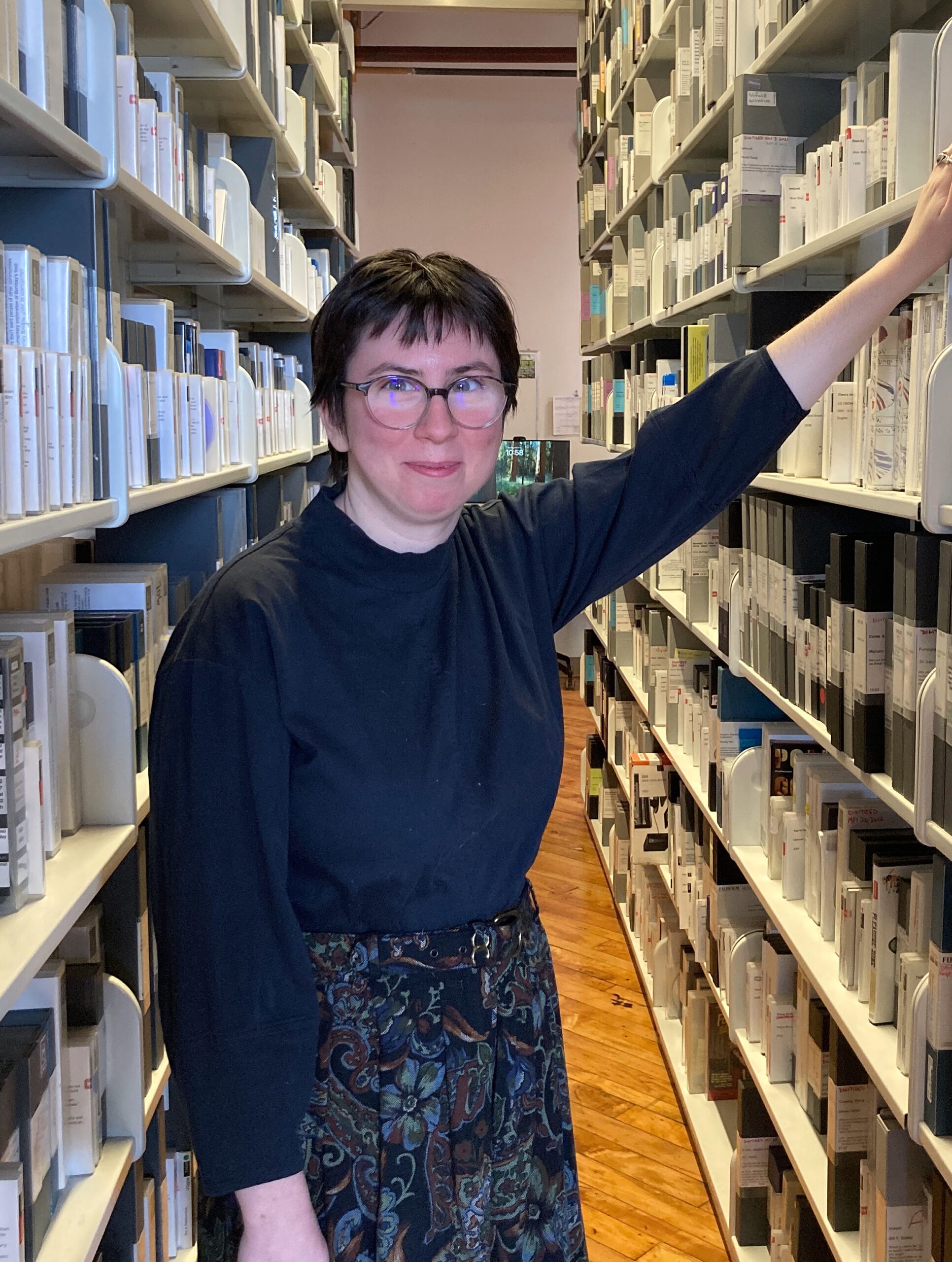
Fiona Enright was hired to work at Vtape in October, on a 23-week Young Canada Works Internship, as a Digital Asset Management Intern. Fiona is an artist and information professional who has a BFA in Drawing and Painting from OCAD University and a Master of Information Studies from McGill University. As she enters the final month of her contract, we asked Fiona to say something about the work she has been doing at Vtape:
“Since October 2025, I have had the pleasure of working at Vtape as a Digital Asset Management Intern, cataloguing works from Vtape’s collection of video art, documentaries, installations, and more. Working with Vtape’s collection has presented cataloguing challenges that are both complex and intellectually stimulating.
“One of the most rewarding parts of the internship is the opportunity not only to watch a lot of work, but also to critically engage with it. Vtape’s distribution catalogue spans decades, genres, conceptual and formal trends, and successive technological developments. The value of exposing yourself to diverse artistic expression, and a lot of it, cannot be overstated: the most common piece of advice I received during my time in art school was to “look at art!” and this was absolutely spot-on. On top of that, being in an environment where everyone is both passionate and knowledgeable about media arts is personally and professionally rewarding. I love talking to Wanda, Chris, Claudia, and Dylan about what I am watching and tapping into their inimitable collective knowledge.
“Vtape’s distribution catalogue provides a ripe environment for an exploration of key issues in the organization of information. Works that are conceptually dense, especially those that engage with ideas in an intentionally oblique fashion, are especially challenging to catalogue. I think of it as a game of ‘semantic whack-a-mole.’ In the same way that adding or removing formal elements can drastically change an artwork’s meaning and interpretation, different combinations of genre, subject, and keyword tags can alter both a user’s search and retrieval experience and their perception of an artwork. The onus is on the cataloguer to consider both the work itself – what techniques were used, what it is trying to say – and what a user would expect to see when searching for this work or ones like it. On the one hand, you have a responsibility towards the artist. And on the other hand, towards the user/viewer.
“Prior to Vtape, I worked in taxonomies and cataloguing in corporate environments, and part of my role as an intern has been to start the process of developing a controlled keyword vocabulary for Vtape’s collection. Semantic considerations become ever more apparent when developing a controlled vocabulary, which is simply a list of terms used to enhance search and retrieval efficiency for a wide array of materials and information. A quintessential controlled vocabulary is the set of Library of Congress Subject Headings (LCSH), which organizes books based on discipline and subject. Although controlled vocabularies originated in library and information science, controlled-vocabulary development has become increasingly popular in the corporate world in the past 20 years or so through taxonomies, ontologies, and knowledge graphs. Quick and intuitive access to information coupled with consistency of descriptive language has obvious utility for any organization, and Vtape is no exception.
“There is a notable lack of publicly available controlled vocabulary/taxonomy projects for media arts. While there are several available specifically for film, and for visual arts more broadly (e.g. Getty Research Institute’s Art and Architecture Thesaurus), media arts are either underrepresented or entirely unrepresented. In conjunction with my cataloguing work, I am looking at the existing keywords that have been used to tag the collection, and through a process of adding, subtracting, and hierarchical arrangement I am crafting a controlled vocabulary that can accurately describe specific artworks. Importantly, I am also producing documentation that will facilitate further controlled-vocabulary development at Vtape beyond my internship. I am very excited to see how the controlled vocabulary grows and changes in the future, especially as it is suffused with different people’s conceptual horizons over time.
“I am immensely grateful to have been given this opportunity to increase access to Vtape’s remarkable distribution collection through cataloguing and controlled-vocabulary development. Thank you, Vtape!”
Fiona has been a joy to work with, as well as being fantastically productive and helpful, cataloguing many works with great care, but at speed, and developing a controlled vocabulary for keywords for our video works!
Vtape thanks the federal government’s Young Canada Works at Building Careers in Heritage program, and their delivery partners at the Canadian Museums Association, for their ongoing support of Vtape’s collections-management work.