
Everyone at Vtape was very sad to learn that Nobuo Kubota left this world on September 30th. We will remember him as a person of exceptional kindness, creativity, and positivity.
Nobuo Kubota, 1932 – 2025
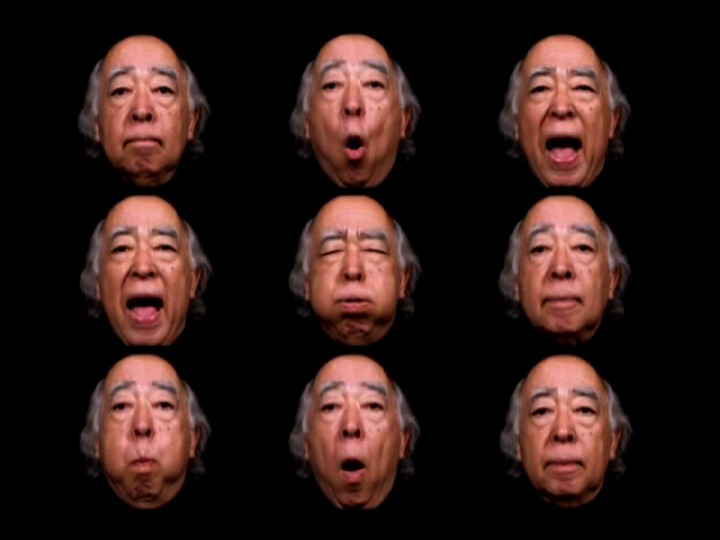
Nobuo Kubota was born in Canada in 1932. His family’s experience represents one of the great injustices of Canadian history: although his father fought for the British empire during WW I, including participation in the battle of Vimy Ridge, the entire family was interned in the Slocan Valley during WW II. Here, young Nobuo studied the Japanese language. In 1959, he graduated with honours from the University of Toronto’s architecture program, and practiced for a decade before turning to art-making. Kubota was a Buddhist, and spent more than a year in Japan studying to become a monk. Both architecture and Buddhism informed his art-making for the rest of his life.
Kubota was a prolific creator of visual art, including architecturally inflected sculptures and technically innovative paintings. By the late 1960s, he became involved in music through the Artists’ Jazz Band, and later CCMC, and improvisation and sound art soon became central to his art. No one who ever saw and heard him performing would be likely ever to forget the experience: Kubota’s extended vocal technique explored the boundaries of the human voice, and although not based in language, it used the phonic and sonic elements of speech to create a new and explosive form of communication. As a vocalist, he performed in some of the world’s most prestigious sound poetry festivals. He published two books, Phonic Slices and Deep Text, with Coach House Books.
In 2009, Nobuo Kubota received a Governor General’s Award in Visual and Media Arts, and was awarded a Doctor of Fine Arts, Honoris Causa, from OCAD University.
Annette Mangaard’s just-finished documentary about Nobuo Kubota, I AM THE ART NOBUO KUBOTA premiere’s at Toronto’s Hot Docs cinema on Sunday, Dec. 7 at 6:30 pm; for tickets go here.
Artist Annette Mangaard was a student of Kubota’s at OCAD in 1977, and later collaborated with him on a number of projects. She shared her memories of him: “He was the epitome of kindness, generosity, creativity and patience. I learned so much from him and know that he will always be with me in spirit. I will miss his upbeat, positive energy and indomitable spirit. Nobi was such a life force and a hugely talented man.”
Image credits: home page: Sounds Like Kubota, by Nobuo Kubota & Annette Mangaard (2006); Loop Holes, by Nobuo Kubota & Annette Mangaard (2008)